
Flow-Next
A local workflow plugin that connects durable specs, isolated implementation, cross-model review, evidence receipts, pull requests, and landing across Claude Code, Codex, Cursor, Droid, Grok Build, and OpenCode.
Project overview
Flow-Next is a local plugin that moves coding agents from disposable chat sessions into a reproducible engineering workflow. It captures work as a durable spec, implements it with fresh-context workers, assigns independent roles to spec compliance and code-quality review, and stores test, QA, review, and PR outcomes as receipts. Project state lives in the repository under .flow/, so work can resume across sessions and agent handoffs. The plugin supports several coding hosts, but it inherits each host's file, shell, model, and GitHub permissions; teams should set clear automation limits, merge policy, and sensitive-repository boundaries before adoption.
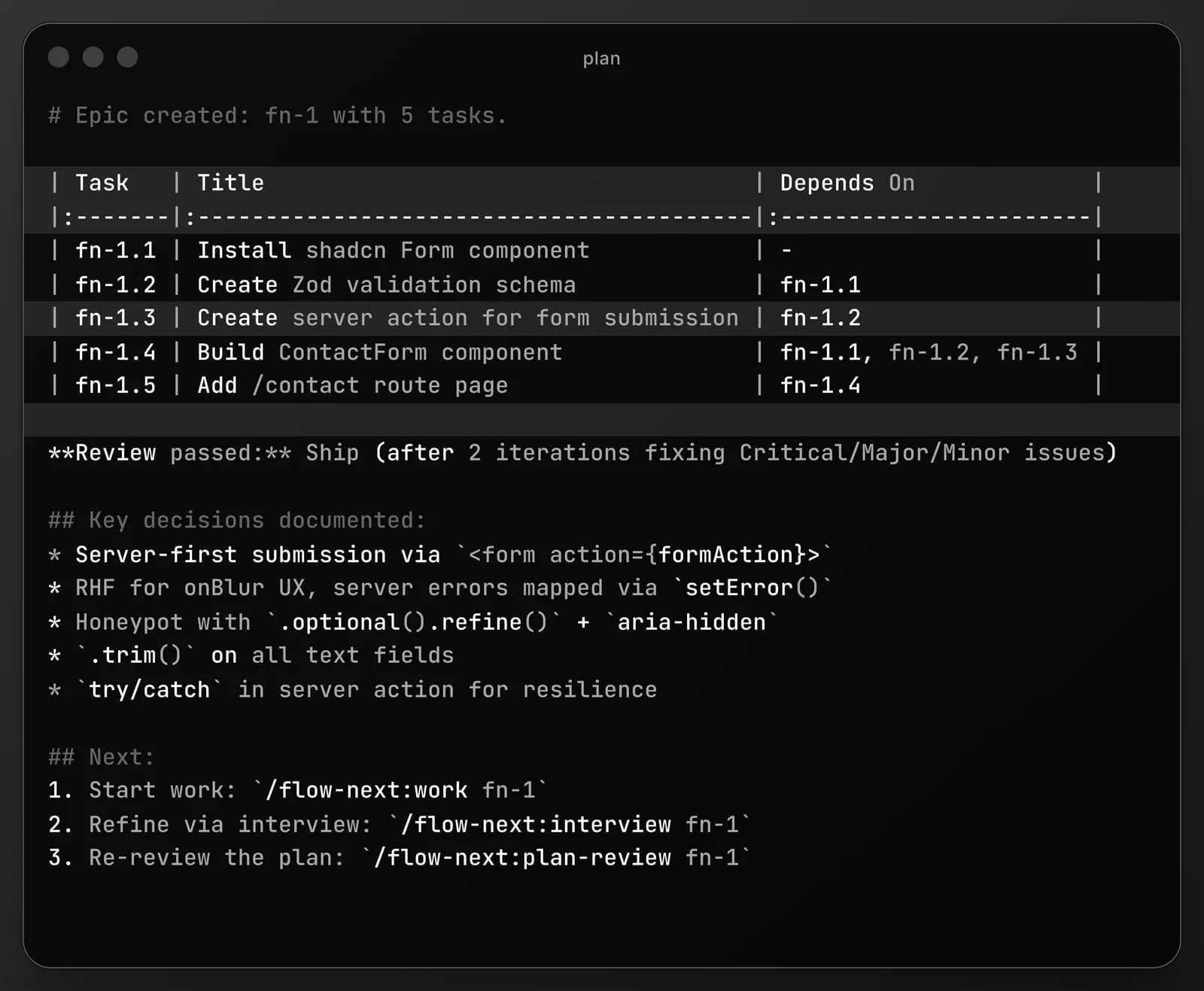
Core capabilities
Durable specs and context recovery
capture writes tasks and decisions under .flow/, allowing later workers to continue from explicit specs and project memory rather than the full chat history.
Role-separated implementation and review
The workflow can dispatch implementers, spec reviewers, and code-quality reviewers, using fresh contexts or different models where the host supports them.
Evidence and receipts
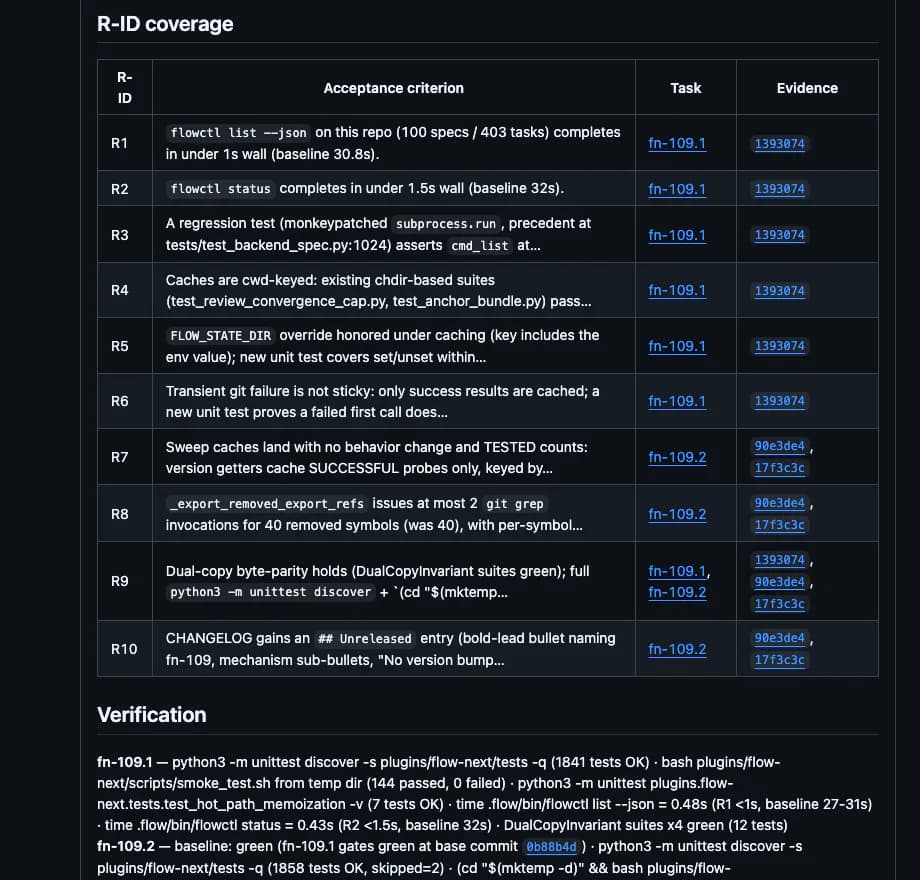
Tests, human QA, review outcomes, and delivery state are captured as structured evidence. The worked example shows review finding and fixing Git color output that broke reference parsing.
PR and landing controls
The workflow can open evidence-bearing PRs, resolve feedback, and land changes. Version 6.0.0 requires land to name one PR, while --until=merge merges only when current authorization and GitHub gates allow it.
Cross-host workflow
The same workflow concepts map to Claude Code, Codex, Droid, Cursor, Grok Build, and OpenCode, with host-specific commands and automation behavior.
Installation and usage
Choose a host, pin a reviewed release, and install into a test repository. Run setup only to initialize project state, then verify specs, implementation, review, and the draft-PR boundary with a low-risk task. Do not enable Ralph automation or automatic merging during the first validation.
Let an AI Agent install it
Send this prompt to Codex, Claude Code, or another AI agent that can work with your local environment.
Help me install and minimally verify Flow-Next in an isolated test repository. Project: https://github.com/gmickel/flow-next. First read the README, platforms guide, install-codex.sh, SECURITY.md, and latest release. Confirm Python 3.11+ and, for Codex multi-agent roles, CLI 0.102.0+. Pin the version I specify; if I do not specify one, show me the latest release and exact commit before installation. Explain every write to CODEX_HOME and project .flow/ before running installation and setup. Verify only a documentation task through spec, implementation, independent review, test receipt, and draft PR. Do not enable Ralph, access a production repository or secrets, configure external trackers, use --until=merge, auto-merge, force-push, or expand gh permissions. Finish with all file and configuration changes, evidence, rollback steps, and still-unverified capabilities.- Python 3.11 or newer
- A supported coding-agent host and access to the intended models
- Codex CLI 0.102.0 or newer for multi-agent roles
- jq, gh, and human-completed GitHub login for review and PR workflows
- Permission to create .flow/, branches, commits, and a draft PR in a test repository
/plugin marketplace add https://github.com/gmickel/flow-next
/plugin install flow-next
/reload-plugins
/flow-next:setup- 1Pin a version and prepare the host
Check Python, host version, and model access, then choose a reviewed Flow-Next tag. Add jq and least-privilege gh credentials only if PR work is needed.
- 2Install and initialize a test repository
Follow the host guide, run setup, and inspect changes under CODEX_HOME or the plugin directory and the repository's new .flow/ state.
- 3Capture one low-risk spec
Describe a small documentation task through flow or capture, then review its goals, acceptance criteria, and constraints before implementation.
- 4Inspect reviews and receipts
Confirm that spec review, code-quality review, tests, and human QA produce evidence and that failures return to a repair loop.
- 5Stop at a draft PR for human judgment
For the first run, create only a draft PR and inspect the diff, permissions, and Git state. Do not pass --until=merge until policy is proven.
Run setup in an isolated test repository and confirm the expected .flow/ files and instruction changes. Give flow a documentation-only task and let it produce a spec, implementation, reviews, test receipts, and a draft PR. Inspect the PR diff, evidence, and local Git state. Do not pass --until=merge or enable Ralph; close or merge the test PR manually after review.
- The Codex installer targets the active CODEX_HOME, so verify that path before running it.
- setup writes project-level .flow/ state and an instruction snippet; inspect the Git diff.
- Merge requires an explicit --until=merge or a land call naming one PR and remains subject to current authorization, checks, reviews, threads, and repository protection.
- bun is only used by the deprecated Ralph TUI and is not a core dependency.
- When upgrading to version 6.0.0, bare or scheduled land no longer discovers PRs; eight land.* keys and make-pr's --no-mermaid option are retired.
Use cases
Spec-driven delivery of complex features
Turn cross-file work into acceptance criteria before independent roles implement and review it, reducing goal drift in long sessions.
Resume interrupted development
Use specs, decisions, and receipts under .flow/ so a fresh session or agent can continue from explicit state.
Adversarial cross-model review
Where the host supports it, choose different models for implementation and review to check spec compliance and code quality.
Evidence-rich draft PRs
Carry test, human-QA, and review outcomes into a draft PR as a traceable delivery record.
Assessment
Flow-Next's value is not another code-generation command; it turns specs, context isolation, independent review, and evidence receipts into a recoverable repository workflow. That is attractive for long tasks, multi-agent work, and disciplined PR delivery. The cost is more state, role calls, and tool authority, and workflow structure cannot replace project tests, security review, or branch protection. Version 6.0.0 turns the PR body into a reviewer briefing and narrows landing to one named PR per invocation. That is a clearer boundary, but automatic merge still belongs behind isolated validation and strong repository gates.
Why it may be useful
- Specs and workflow state remain in the repository and survive session boundaries
- Implementation and review roles are separated and can use different models
- Evidence receipts connect tests, QA, reviews, and decisions to delivery
- The plugin covers several mainstream coding-agent hosts
- Version 6.0.0 structures the PR briefing around acceptance criteria and review steps
- The MIT-licensed repository was still publishing and committing on 2026-09-21
What to know first
- Multiple roles and models increase latency, quota consumption, and coordination cost
- Commands, hooks, and autonomous-loop support differ across hosts
- The installer writes several host configuration and plugin directories, so upgrades deserve a diff review
- PR workflows depend on gh permissions, while tracker bridges widen the external data boundary
- Automated review and receipts cannot prove the absence of regressions or security defects
- Installation and end-to-end behavior were not tested in this review
README
Flow-Next
Overview
A local workflow plugin that connects durable specs, isolated implementation, cross-model review, evidence receipts, pull requests, and landing across Claude Code, Codex, Cursor, Droid, Grok Build, and OpenCode. Repeatable agentic engineering. The workflow layer that turns AI coding agents into a disciplined factory: durable specs, fresh-context workers, adversarial cross-model reviews, receipts. Everything in your repo, zero dependencies. Claude Code · Codex · Cursor · Droid.
Getting started
- Choose a host, pin a reviewed release, and install into a test repository. Run setup only to initialize project state, then verify specs, implementation, review, and the draft-PR boundary with a low-risk task. Do not enable Ralph automation or automatic merging during the first validation.
- Flow-Next organizes capture, implementation, review, PR creation, and landing around durable specs, keeping state and evidence in the repository.
- The main flow entry point can start from natural-language work; capture, work, make-pr, resolve-pr, and land are available for more control.
- Run setup in an isolated test repository and confirm the expected .flow/ files and instruction changes. Give flow a documentation-only task and let it produce a spec, implementation, reviews, test receipts, and a draft PR. Inspect the PR diff, evidence, and local Git state. Do not pass --until=merge or enable Ralph; close or merge the test PR manually after review.
Configuration
/plugin marketplace add https://github.com/gmickel/flow-next
/plugin install flow-next
/reload-plugins
/flow-next:setup