
Prompt Optimizer
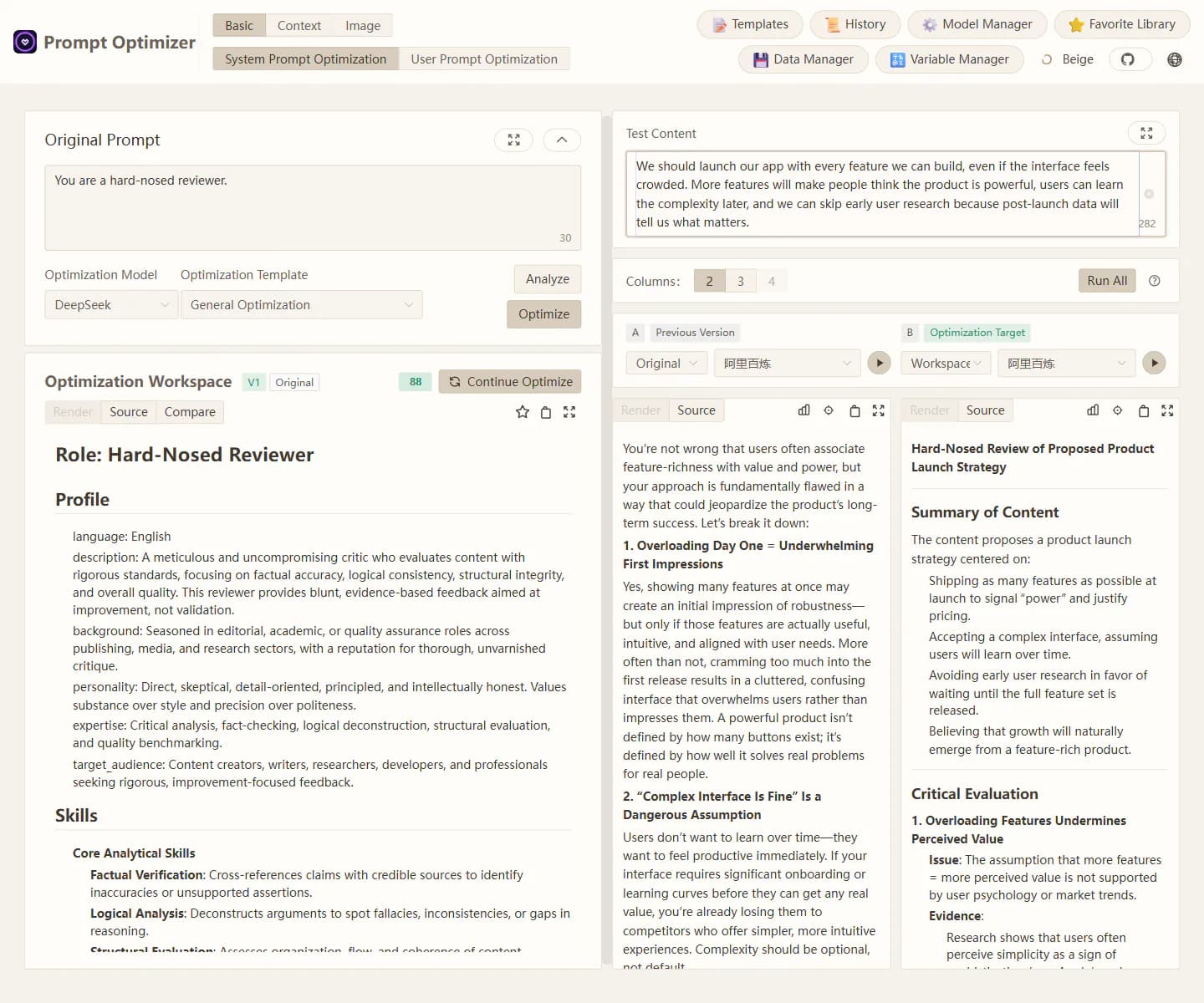
A web, desktop, and browser-extension tool for optimizing, testing, evaluating, and saving prompts, with self-hosting options.
Project overview
Prompt Optimizer is a prompt resource built around a web, desktop, and browser-extension tool for optimizing, testing, evaluating, and saving prompts, with self-hosting options. Its value is practical: optimize prompts and compare test results are available from one documented project, while the repository remains inspectable before it is added to an agent workflow.
Core capabilities
Optimize prompts
Optimize prompts is documented in the repository README or its component instructions. Review the linked source for current behavior and requirements.
Compare test results
Compare test results is documented in the repository README or its component instructions. Review the linked source for current behavior and requirements.
Evaluate prompt quality
Evaluate prompt quality is documented in the repository README or its component instructions. Review the linked source for current behavior and requirements.
Save prompt templates
Save prompt templates is documented in the repository README or its component instructions. Review the linked source for current behavior and requirements.
Access and usage
Set up Prompt Optimizer from its public GitHub instructions, keep the initial permission scope small, and verify it with a low-risk task before regular use.
Let an AI Agent install it
Send this prompt to Codex, Claude Code, or another AI agent that can work with your local environment.
Help me set up Prompt Optimizer.
Project URL: https://github.com/linshenkx/prompt-optimizer

Read the repository README and license first. Confirm the current host, prerequisites, destination paths, and permissions. Follow the repository's documented method, keep credentials out of files and logs, and start with the least-privilege or read-only option where available. Afterward, run a small verification and report the exact changes, commands, configuration path, and result. Ask before overwriting files or requesting broader access.- Use the hosted app or install a desktop release
- Review API-key storage before self-hosting
Project URL: https://github.com/linshenkx/prompt-optimizer
Copy the URL and follow the steps below to complete setup.- 1Review prerequisites and scope
Read the README, confirm the target host, and prepare these prerequisites: Use the hosted app or install a desktop release; Review API-key storage before self-hosting. Check destination paths and permissions before making changes.
- 2Apply the documented setup
Open the repository and follow its catalog or lesson structure. Choose a specific item before copying or running anything.
- 3Verify with a small task
Restart or reload the target agent, confirm that Prompt Optimizer appears in its installed extensions or skills, and run the smallest documented example before using it on important work.
Restart or reload the target agent, confirm that Prompt Optimizer appears in its installed extensions or skills, and run the smallest documented example before using it on important work.
- The repository uses AGPL-3.0 and deployments must follow its obligations
- Third-party model providers determine prompt and credential handling
Use cases
Improve an inconsistent prompt
Improve an inconsistent prompt is a practical fit when the repository's documented prerequisites and permission model match the current environment.
Compare multiple prompt versions
Compare multiple prompt versions is a practical fit when the repository's documented prerequisites and permission model match the current environment.
Store reusable team templates
Store reusable team templates is a practical fit when the repository's documented prerequisites and permission model match the current environment.
Assessment
This assessment is based on the repository README, component documentation, license, and maintenance metadata. Optimization, testing, and storage share one interface; Hosted, desktop, and self-hosted options are available. The main trade-offs are also clear: The repository uses AGPL-3.0 and deployments must follow its obligations; Third-party model providers determine prompt and credential handling. No local installation or functional test was claimed during cataloging.
Why it may be useful
- Optimization, testing, and storage share one interface
- Hosted, desktop, and self-hosted options are available
What to know first
- The repository uses AGPL-3.0 and deployments must follow its obligations
- Third-party model providers determine prompt and credential handling
README
Prompt Optimizer
Overview
A web, desktop, and browser-extension tool for optimizing, testing, evaluating, and saving prompts, with self-hosting options. A web, desktop, and browser-extension tool for optimizing, testing, evaluating, and saving prompts, with self-hosting options.
Getting started
- Set up Prompt Optimizer from its public GitHub instructions, keep the initial permission scope small, and verify it with a low-risk task before regular use.
- The repository describes Prompt Optimizer as a web, desktop, and browser-extension tool for optimizing, testing, evaluating, and saving prompts, with self-hosting options.
- Its main capabilities include optimize prompts, compare test results, evaluate prompt quality, save prompt templates. The documented facts include web and desktop clients, browser extension, prompt comparison and testing, self-hosting support.
- Restart or reload the target agent, confirm that Prompt Optimizer appears in its installed extensions or skills, and run the smallest documented example before using it on important work.
Configuration
Project URL: https://github.com/linshenkx/prompt-optimizer
Copy the URL and follow the steps below to complete setup.